2026 update: Watt If
I revisited the original calculator as Watt If, a more complete and location-flexible home-energy checkup. It keeps the roof-tracing and solar-resource foundation while adding local tariffs and equipment prices, bill-driven system sizing, adjustable roof direction and shading, monthly energy-flow estimates, backup-battery scenarios, and a ten-year payback comparison.
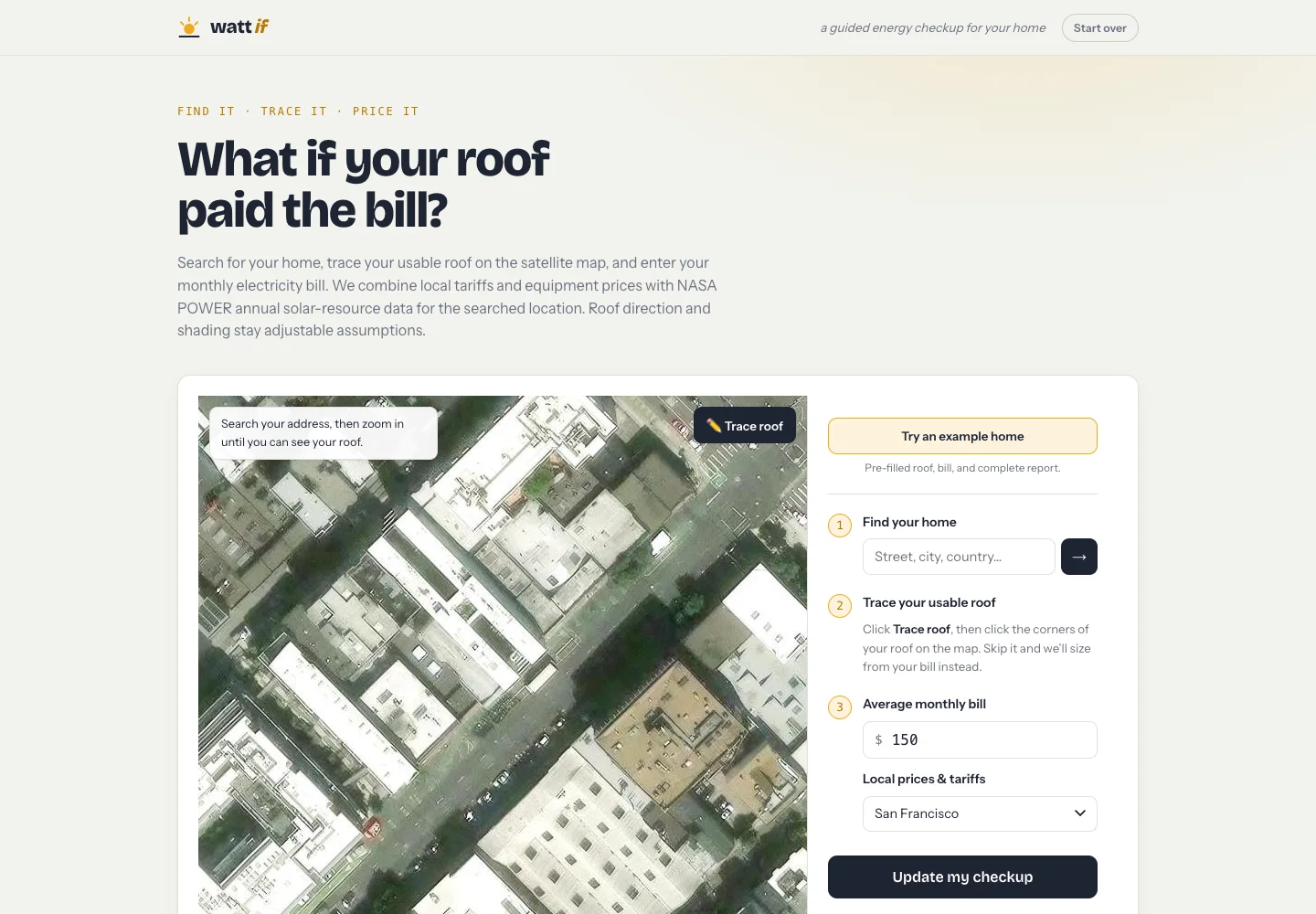
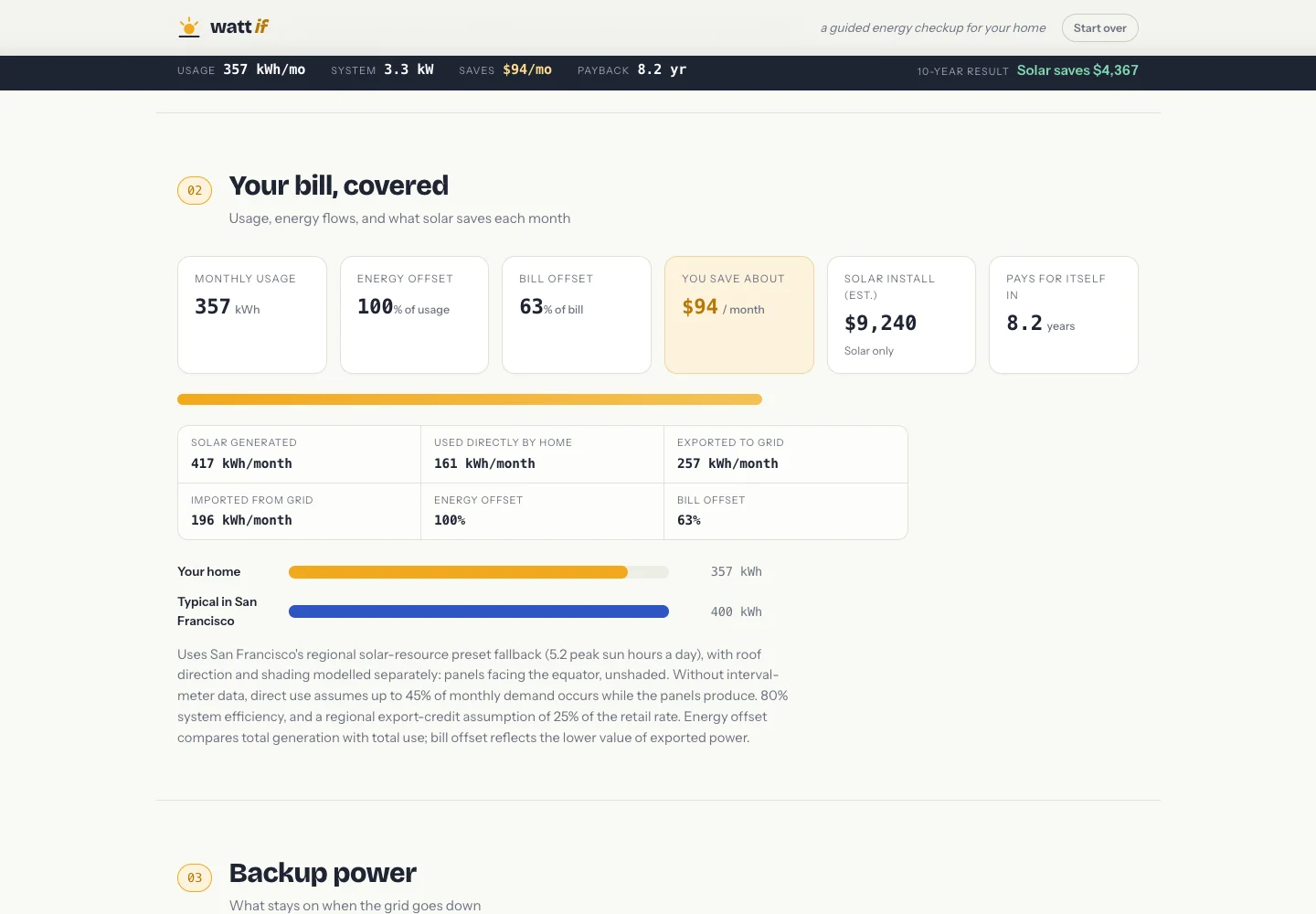
The shared example uses a San Francisco home and a $150 monthly bill to show the recommendation, energy and bill offsets, estimated installation cost, savings, and payback period.
The idea
Estimate the solar potential of a specific rooftop instead of asking somebody to reason from a rough address or property description.
How it works
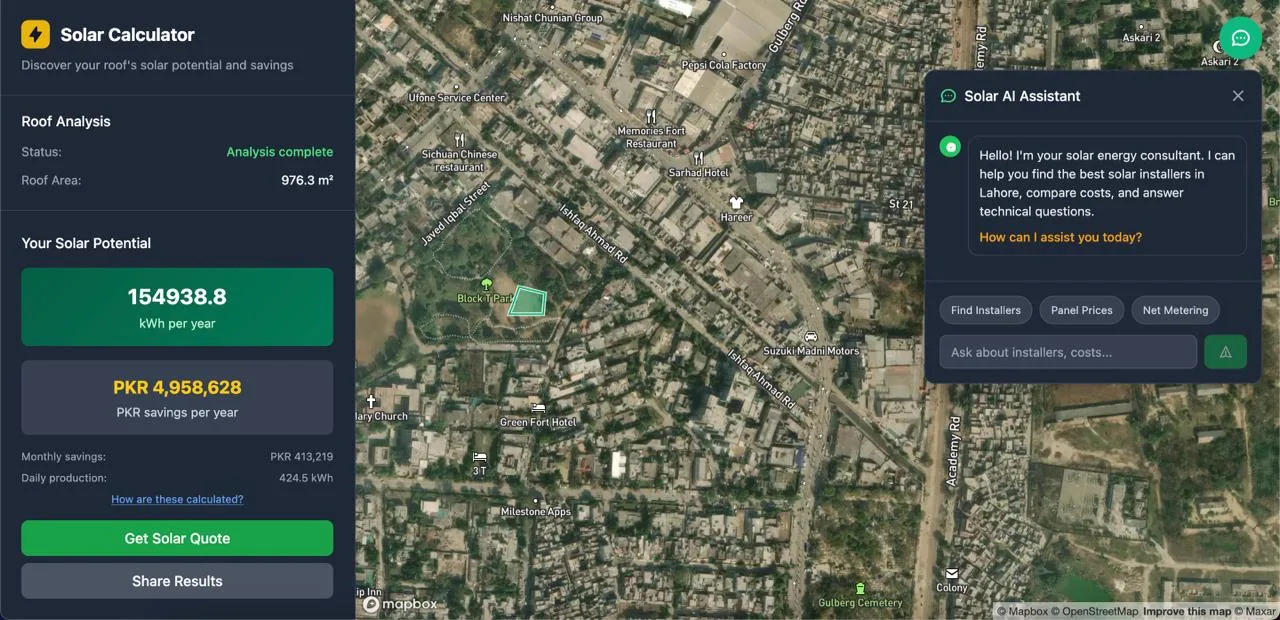

Users draw a rooftop polygon on satellite imagery. The app calculates area, fetches location-specific solar radiation data from NASA POWER, applies pvlib models, and estimates annual energy production and financial savings.
What it combines
- Mapbox satellite imagery and polygon drawing
- Geospatial area calculations with Turf.js
- NASA POWER irradiance data
- Solar modeling with
pvlib - A Python and Flask backend with cached calculations
The main calculation converts hourly irradiance into plane-of-array estimates, then applies panel efficiency, system-loss, and usable-roof assumptions. Results are cached by rounded coordinates and year so nearby repeat calculations do not keep hitting the upstream API.
Implementation detail
The backend keeps the API small: the browser sends GeoJSON and measured area, the server finds the polygon centroid, calls the solar model for that coordinate, and scales the result by usable roof area.
centroid = shape(geometry).centroid
area_m2 = float(data["area"])

kwh_per_m2, pkr_per_m2 = power_hourly(centroid.y, centroid.x)

total_kwh = round(kwh_per_m2 * area_m2, 1)
total_pkr = round(pkr_per_m2 * area_m2)
Graceful fallback
If the upstream irradiance request or the full model fails, the app falls back to a simpler latitude-based estimate instead of leaving the user without a result.
Installer assistant
The prototype also passes available roof area, location, and savings context into an installer-recommendation assistant. It can query a small local knowledge base for region-aware recommendations and market information without asking the user to repeat details already captured by the map.
The project is specific to Pakistan, where a practical estimate in local currency is more useful than a generic solar calculator.